



Everyone keeps telling us that the future of power is a cloud‑only AI that will magically balance the grid. The counter‑intuitive truth? The real wizardry lives at the edge, where each transformer, meter, and streetlight becomes a tiny brain that talks directly to the rest of the network. That’s what we call Smart Grid edge intelligence—a decentralized chorus that can sense, decide, and act faster than any central server. I first saw it in my own garage: a sudden dip in my EV charger was instantly corrected by a nearby sensor whispering a power‑shift command, before I even thought to check the dashboard.
In this guide I’ll walk you through the exact steps to turn that whispering chorus into a reliable, secure, and scalable system for your utility or micro‑grid. You’ll learn how to pick the right edge hardware, stitch together low‑latency data pipelines, and embed lightweight AI models that keep the lights on without a cloud‑centered bottleneck. Expect real‑world examples, checklist‑ready configurations, and a no‑fluff safety playbook—so you can start building a future‑ready grid today, one edge node at a time, for your community and beyond.
Table of Contents
- Project Overview
- Step-by-Step Instructions
- Smart Grid Edge Intelligence Cosmic Currents for Realtime Power
- Aidriven Demand Response Meets Distributed Energy Integration
- Edge Computing for Power Distribution Lowlatency Data Fusion
- Quantum Pulse: 5 Edge‑Smart Grid Hacks
- Key Takeaways
- Quantum Pulse of the Grid
- Conclusion: Powering Tomorrow's Grid
- Frequently Asked Questions
Project Overview

Total Time: 3 hours
Estimated Cost: $150 – $300
Difficulty Level: Intermediate
Tools Required
- Raspberry Pi 4 (or similar single-board computer) ((with heatsink and fan for thermal management))
- USB Ethernet adapter ((for network connectivity if Pi lacks Ethernet port))
- Soldering iron ((for any custom sensor wiring))
- Multimeter ((to verify power and signal integrity))
- Cable crimping tool ((for making reliable RJ45 connections))
Supplies & Materials
- Edge AI software stack (e.g., TensorFlow Lite, EdgeX Foundry)
- MicroSD card (32 GB or larger) (Pre‑loaded with OS and AI runtime)
- Ethernet cable (6 feet or longer)
- Power supply (5 V 2.5 A USB‑C) (Ensures stable operation)
- Enclosure for the SBC (Preferably with ventilation)
- Sensors (e.g., voltage, current, temperature) (Choose based on the specific grid data you want to monitor)
Step-by-Step Instructions
- 1. Kick off with a visionary audit – Grab your grid’s data pipeline and map every sensor, controller, and communication node like you’re charting a star‑map. Jot down latency, bandwidth, and processing power for each point, then flag the “edge‑ready” spots where a tiny AI brain could start whispering insights in real time.
- 2. Select your edge‑AI sidekick – Choose a lightweight, container‑friendly inference engine (think TensorFlow Lite or Edge‑Impulse) that can zip through voltage spikes, load forecasts, and fault detections on a modest micro‑controller. Make sure it plays nice with your existing SCADA protocols so the edge can chat fluently with the central hub.
- 3. Deploy a sandboxed model – Train a predictive algorithm on historical grid data (load curves, renewable output, weather patterns) and wrap it in a Docker‑style sandbox. Push this sandbox to a pilot substation, then run a controlled “shadow mode” where the edge AI watches but doesn’t yet act, letting you compare its predictions against the legacy system.
- 4. Validate with a digital twin – Spin up a high‑fidelity simulation of your local distribution network in a VR sandbox. Feed the edge AI its live sensor streams, then watch how it tweaks voltage regulation or re‑routes power in the virtual world. Tweak thresholds until the twin’s performance meets your reliability and efficiency targets.
- 5. Roll out incremental autonomy – Once the twin gives you a thumbs‑up, enable the edge AI to execute micro‑decisions—like shedding non‑critical loads or nudging battery storage—directly on the field device. Keep a human‑in‑the‑loop dashboard that logs each autonomous move for audit and continuous learning.
- 6. Monitor, iterate, and scale – Set up a telemetry dashboard that visualizes edge AI health, latency, and confidence scores. Establish a weekly “pulse check” to retrain models with fresh data, and gradually expand the edge rollout to neighboring substations, turning the whole grid into a living, learning organism.
Smart Grid Edge Intelligence Cosmic Currents for Realtime Power

If you’re already feeling the electric buzz of edge‑savvy power flows and want a hands‑on sandbox to experiment with latency‑busting analytics, I’ve been tinkering with a community‑curated toolkit that stitches together lightweight container runtimes, time‑synchronised telemetry, and a sleek visual dashboard—all wrapped in a retro‑futuristic UI that feels like stepping into a cyber‑arcade. The project lives on a repository I’ve bookmarked for quick reference, and the entry point is conveniently hosted at ao hure, where you can clone the starter kit, spin up a demo grid, and watch your data whisper across the edge in real‑time. Trust me, this little gem will have your test‑bed humming like a solar‑charged synthwave arcade before you know it.
When you lace your distribution network with edge nodes, the magic shows up in the blink of a photon. By deploying compact micro‑data centers right next to transformers, you shrink the communication loop so that low‑latency data analytics in utilities become a daily reality. Think of each node as a miniature command deck that pre‑processes voltage spikes, forecasts load curves, and streams only the most relevant packets to the cloud. A handy tip is to containerize your AI inference engines—Docker‑wrapped, auto‑scaled, and ready to spin up on a 5 ms whisper—so that real‑time grid monitoring stays as smooth as a holo‑glide.
Beyond the hardware, the real game‑changer is the choreography between AI‑driven demand response and distributed energy resource integration. Let local solar farms and battery packs feed their generation forecasts straight into the edge, where a federated‑learning model refines its predictions without ever exposing raw data. This not only boosts accuracy for load‑shedding decisions but also fortifies cybersecurity for smart grids by keeping sensitive telemetry off the wide‑area network. In practice, schedule a nightly “edge‑audit” script that checks model drift and re‑trains any outliers, ensuring your power‑grid orchestra stays in perfect sync, even as the sun sets on the horizon.
Aidriven Demand Response Meets Distributed Energy Integration
Imagine the grid as a living nebula, where AI‑piloted demand‑response algorithms sense the flicker of a rooftop solar panel or the hum of a neighborhood battery bank and instantly rewrite consumption scripts. Edge‑node brains whisper to each other, trimming peaks before they even appear, turning what used to be a blunt‑force load‑shedding drill into a graceful, predictive dance of kilowatts for the grid’s rhythm, syncing with renewable tides and user habits alike.
At the edge, micro‑inverters, home‑grid controllers, and community storage hubs become co‑pilots, feeding real‑time status into a shared AI cockpit. When a sunny suburb suddenly over‑produces, the system auto‑allocates excess juice to a neighbor’s electric‑vehicle fleet or a municipal micro‑grid, all while maintaining voltage stability. The result? A decentralized ballet where every amp is choreographed, turning distributed energy from a wild frontier into a tight‑rope act of harmonious power flow.
Edge Computing for Power Distribution Lowlatency Data Fusion
Imagine the distribution hub as a neon‑lit cockpit where every sensor, transformer, and solar inverter streams its pulse to a local edge node faster than a photon in a warp tunnel. Those edge computers splice together voltage, frequency, and weather feeds in microseconds, fusing raw telemetry into a coherent, low‑latency tapestry. Because the decision‑making lives right at the grid’s edge, a sudden dip in solar output can be countered instantly by rerouting stored energy, all without waiting for a distant cloud server to catch up. This near‑instantaneous data choreography keeps the lights humming, the grid balanced, and the carbon footprint lean, turning what used to be a sluggish, centralized ballet into a hyper‑responsive, decentralized jam session. In short, low‑latency data fusion is the secret sauce that lets our smart grid riff in real time, keeping the power groove smooth and future‑ready.
Quantum Pulse: 5 Edge‑Smart Grid Hacks
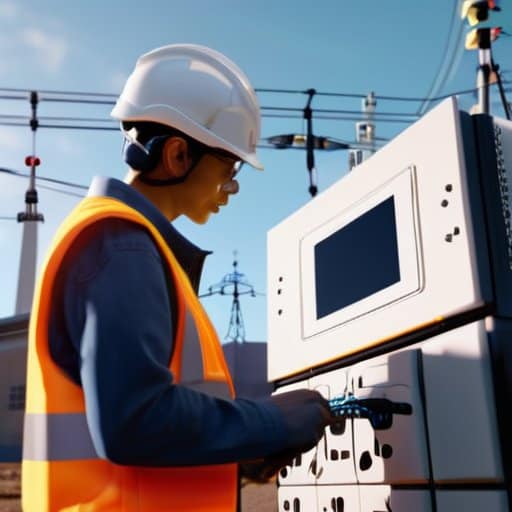
- Deploy micro‑edge nodes at substations so voltage‑frequency tweaks happen in nanoseconds, not minutes.
- Fuse real‑time telemetry with federated AI models to predict load spikes before the grid even feels the surge.
- Leverage blockchain‑anchored certificates for distributed energy resources, letting rooftop solar bid into the market instantly.
- Implement adaptive latency buffers that auto‑scale based on renewable variability, keeping power flow smooth as a synthwave beat.
- Enable secure, over‑the‑air firmware updates for edge devices, ensuring every sensor stays future‑ready without a service outage.
Key Takeaways
Edge‑enabled grids turn every sensor into a real‑time storyteller, letting utilities anticipate demand spikes before they ripple through the network.
AI‑driven demand response fuses distributed energy resources into a seamless choreography, letting solar roofs, home batteries, and electric rides sync like a well‑orchestrated space‑age jam session.
Low‑latency data fusion at the edge slashes response times, transforming the grid from a static utility into a living, breathing digital organism that adapts on the fly.
Quantum Pulse of the Grid
When edge intelligence meets the power grid, we turn every kilowatt into a star‑born whisper, syncing the city’s heartbeat with the cosmos in real time.
Evan Carter
Conclusion: Powering Tomorrow's Grid
As we’ve navigated the circuitry of tomorrow, we’ve seen how edge intelligence turns a conventional power network into a living organism that breathes, learns, and adapts in real time. By pushing data processing to the grid’s perimeter, latency drops to milliseconds, enabling lightning‑fast fault detection and seamless coordination of solar, wind, and storage assets. AI‑driven demand‑response algorithms now anticipate consumption spikes before they happen, while federated learning stitches together insights from thousands of micro‑grids without ever exposing a single byte of private data. The result? A resilient, low‑carbon grid that balances supply and demand with precision, all while shaving operational costs and carbon footprints. The grid becomes a collaborative symphony where every node plays its part in harmony.
Looking ahead, the promise of a future‑ready grid isn’t a distant sci‑fi fantasy—it’s a blueprint we can start drafting today. Imagine neighborhoods where rooftop solar whispers to neighborhood storage, where a community app lets residents trade excess kilowatts as effortlessly as swapping NFTs. As we stitch together edge nodes, AI, and renewable resources, we’re not just hardening our infrastructure; we’re composing a new cultural rhythm that celebrates sustainability, equity, and human ingenuity. The next decade will be defined by those who dare to fuse code with canvas, turning the power line into a brushstroke on the canvas of tomorrow. Let’s power that vision, one edge at a time.
Frequently Asked Questions
How does edge computing reduce latency in real‑time grid monitoring and control?
Think of the grid as a neon‑lit highway where every sensor is a street‑lamp sending traffic reports. By moving the crunching power to the edge—right at the substation or transformer—we slash the round‑trip to the cloud down to a few microseconds. That means voltage spikes, faults, or demand surges are spotted and corrected before the flicker even reaches your smart thermostat. In short, edge‑ward processing turns latency into a whisper, letting the grid react in real time.
What security challenges arise when deploying AI‑driven edge nodes across a distributed power network?
Deploying AI‑powered edge nodes into a sprawling power grid throws a few cyber‑cosmic curveballs our way. First, the sheer number of distributed devices expands the attack surface, giving hackers more footholds. Next, real‑time AI models need secure, tamper‑proof data streams—any spoofed sensor reading can skew load‑balancing decisions. Trust‑less firmware updates, credential management, and isolation between critical control loops and ancillary services are also essential, lest a rogue algorithm turn a bright grid into a dark‑side glitch.
Can edge‑based demand‑response algorithms seamlessly integrate with existing utility SCADA systems?
Absolutely—if you give the edge nodes a friendly handshake protocol, they can slide right into the SCADA dance floor. By wrapping the demand‑response logic in OPC‑UA or IEC 61850 wrappers, deploying a lightweight gateway that translates sensor‑level insights into the SCADA’s historian, and syncing with the utility’s digital‑twin twin‑stream, the edge algorithm whispers its “grid‑groove” moves straight into the control loop. In short, with the right middleware, the integration is as seamless as a photon‑zip across a quantum‑cable.